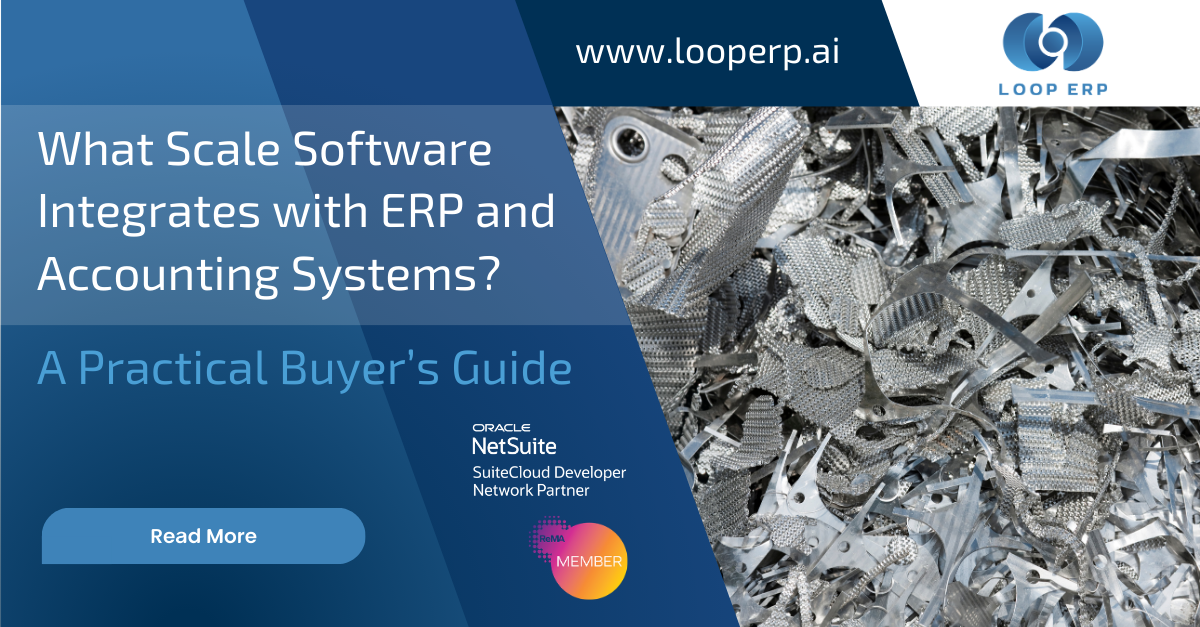
If you’re asking what scale software integrates with ERP and accounting systems, you’re probably dealing with a familiar scenario: the scale house is moving fast, ops needs tickets processed without friction, and finance needs clean numbers that tie out without a week of cleanup.
In scrap, recycling, waste materials, and aggregate operations, the scale is not just a peripheral tool. It is where revenue, inventory, pricing, settlements, compliance, and margin visibility begin. That’s why the real question is not only what scale software integrates with ERP and accounting systems, it’s also: what does integration actually mean in real-world, high-volume environments?
This guide will walk through what to look for, what to avoid, and how to evaluate solutions, including how Loop ERP fits when your goal is a true scale-to-financial workflow.
A lot of vendors will say “yes, we integrate,” but in practice, “integration” can mean anything from a nightly export to a fragile connector that breaks when an exception happens.
When evaluating what scale software integrates with ERP and accounting systems, use these four requirements as your baseline.
Weight alone does not run the business. A complete ticket needs context: customer or vendor, material, grade, location, contract terms, pricing rules, hauler, exceptions, and adjustments. If those fields don’t flow, finance will still be reconstructing the story later.
If ticket data hits finance in batches or after manual review, you create gaps between what ops sees and what finance books. That delay turns into reconciliation, disputes, and late decisions. For many teams, the goal behind what scale software integrates with ERP and accounting systems is real-time alignment, not end-of-month surprises.
Regrades happen. Split loads happen. Price edits happen. An integrated system should keep a clean audit trail while letting teams correct reality quickly. If the “fix” is a spreadsheet plus a journal entry, the integration is not doing the job.
If the scale operator has to “do accounting,” you get slow throughput and bad data. Look for minimal-click workflows with smart defaults that fit the scale house environment.
If you’re still trying to decide what scale software integrates with ERP and accounting systems, this definition of integration will save you from “connected” stacks that still behave like disconnected tools.
Most options that claim to answer what scale software integrates with ERP and accounting systems fall into one of these models.
This is the classic setup: scale tickets export to CSV, accounting imports later. It can work at low volume, but it does not scale well when pricing gets dynamic, sites multiply, or exceptions increase. The hidden cost shows up in labor, cleanup, and slow closes.
This is better, but it depends on what is actually synced, how exceptions are handled, and who owns the connector. Many teams end up with partial integration that still requires manual reconciliation, because edge cases were not designed into the workflow.
This is the most reliable outcome for teams that need operational and financial trust in the same data. Instead of pushing scale records “somewhere else,” the scale transaction becomes the start of a financial workflow that remains traceable all the way to settlement, invoice, and general ledger.
This is a useful lens because the core reason people ask what scale software integrates with ERP and accounting systems is usually to eliminate rework, not to add a new connector to babysit.
Use this checklist in every vendor demo. It will quickly separate “integration” from integration.
If a vendor can’t demonstrate these live, they are not really answering what scale software integrates with ERP and accounting systems for your reality.
If your main objective is what scale software integrates with ERP and accounting systems, then consistent reporting is not a “nice to have.” It is the end goal.
Loop ERP is designed for circular economy operations where ticketing, pricing, inventory, logistics, and finance must stay aligned. Instead of relying on a patchwork of tools connected by exports and connectors, Loop’s approach is to run the workflow in one system that supports how the industry actually operates.
If you want a broader view of Loop’s “one system” approach, these pages are useful starting points:
For teams evaluating what scale software integrates with ERP and accounting systems, the practical difference with an ERP-first approach is this: you stop treating the scale as an external edge system, and start treating the scale ticket as the first record in an operational and financial chain.
If you’re researching what scale software integrates with ERP and accounting systems, you may already be feeling some of these symptoms:
These are rarely people problems. They’re usually architecture problems.
If this sounds familiar, you might also find these posts helpful:
A common failure mode is letting “integration” become a vague goal that means something different to ops and finance.
When aligning stakeholders, define success in plain terms:
If everyone agrees on those outcomes, it becomes much easier to evaluate what scale software integrates with ERP and accounting systems because you’re measuring results, not vendor promises.
For context on how Loop frames ERP for real recycling operations, these are strong companion reads:
If you’re trying to answer what scale software integrates with ERP and accounting systems, don’t stop at “yes, we integrate.”
Instead, evaluate whether the system:
If you want to explore Loop’s perspective on unifying operations and finance, the Loop blog hub is a good place to browse related topics: Loop ERP Blog.

The most reliable answer to what scale software integrates with ERP and accounting systems is the option that minimizes handoffs and exceptions. Look for a workflow where the scale ticket naturally becomes the operational and financial record, with traceability from ticket to settlement, invoice, and general ledger.
Ask for a live demo that starts at the scale ticket and ends at the general ledger, including a regrade and a correction. If they can’t show the full chain, you’re likely buying an export plus cleanup.
Not always, but delays create gaps, and gaps create reconciliation work. If your operation has dynamic pricing, frequent adjustments, or multiple sites, real-time or near real-time workflows become much more important. That is often the real driver behind asking what scale software integrates with ERP and accounting systems in the first place.
Treating the scale as a standalone system and assuming an integration later will be clean. In high-volume environments, “later” becomes permanent wo
Powerful, self-serve product and growth analytics to help you convert, engage.
Blogs
October 1, 2026
Building the 2027 Budget: How to Make the ROI Case for a Scrap ERP Before Year-End
September 23, 2026
Closing the Books on Q3: Why Manual Reconciliation Breaks Down at Quarter-End
September 16, 2026
Material Traceability Software: What ESG and Compliance Teams Actually Need