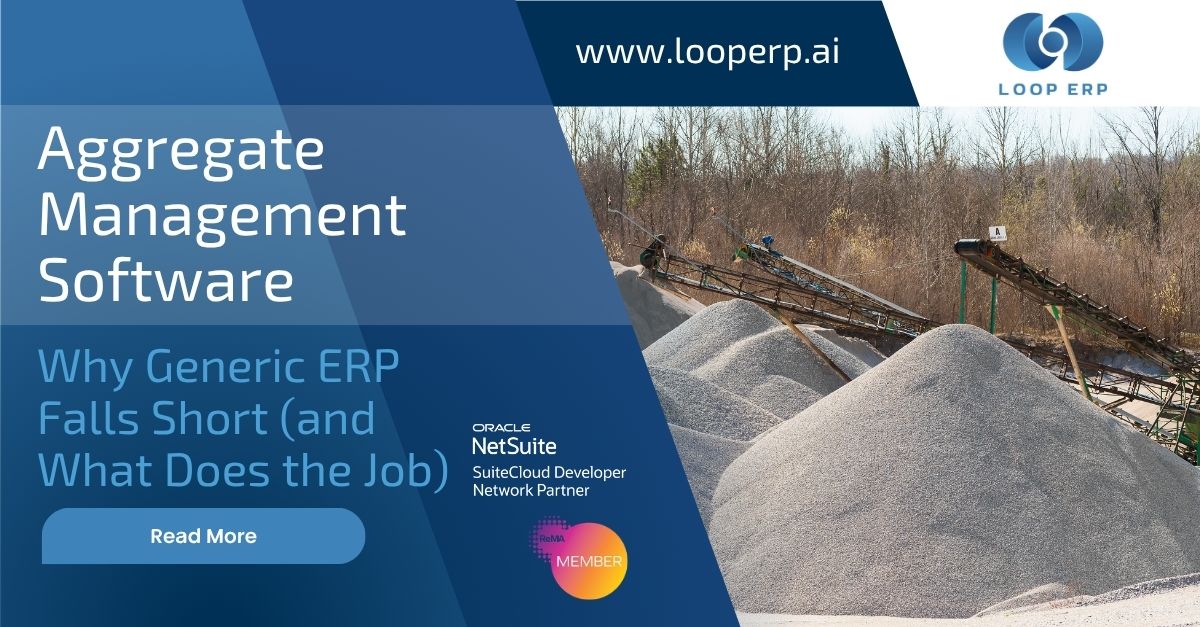
Aggregate operators run on tickets. Trucks pull onto the scale, the operator captures product, weight, customer, job, and haul charge, and the ticket prints. From that single record, a dozen things have to happen. Inventory comes down at the right stockpile. The invoice builds with the right tax and exemption logic. The royalty owner gets paid. Finance closes the month without rebuilding the data from scratch.
Most aggregate businesses don't have software that does all of that in one place. They have scale software, then QuickBooks or a generic ERP, then spreadsheets stitching it together. That gap is where time, margin, and visibility quietly leak out.
If you're shopping for aggregate software or aggregate scale ticket software, here's what to look for, what generic ERP gets wrong, and what actually does the job.
Aggregate is its own animal. The system you choose should be built around operational realities, not adapted from a manufacturing or retail template. At minimum, aggregate software has to support:
Each of these touches accounting. If the ticket lives in one system and accounting lives in another, you'll be reconciling forever.
Generic ERP platforms are built for general business. They handle GL, AP, AR, and inventory well, but they assume your inventory moves in cases and units, not tons across stockpiles. They assume pricing is per SKU, not per zone with haul and royalty layered on. They assume tax is a flat rate, not a maze of exemptions tied to who's buying and what they're using it for.
When operators try to make a generic ERP fit, the workarounds start. Scale tickets get re-keyed into invoices. Inventory gets adjusted manually after every truckload. Royalty calculations get pulled into Excel because the system can't handle the math. Sales tax exemption certificates get tracked on a shared drive. By month-end, finance is rebuilding what already happened on the scale, and visibility into actual pit-level performance is days behind.
The cost shows up in three ways. AR runs late because invoices wait on data entry. Inventory drift makes physical counts painful. Leadership can't see pit-level margin in time to act on it.
This is where most aggregate operators feel the pain first. Scale ticket software, on its own, captures the transaction at the scale. It's good at that. What it usually isn't built to do is push that ticket into accounting in real time, with every layer already applied: haul, royalty, tax, exemption, and contract pricing.
So shops bolt the scale system to QuickBooks or a generic ERP through a nightly sync. By the time the data lands in finance, it's stripped of context and missing the pricing complexity that aggregate billing actually requires. AR teams spend the next morning rebuilding invoices and chasing missing tax codes. Royalty owners wait. Ops can't trust the inventory number on the screen.
The ticket itself should drive the transaction. When aggregate scale ticket software lives separately from accounting, the work of capturing the ticket happens twice, once at the scale and again the next day inside the financial system.
A system built for aggregate operators closes the loop between the scale and the GL. When a truck pulls off the scale, the ticket has already done the work:
That's what aggregate software should do. One login. One system. Total control.
If you operate a single pit, this means you stop running three tools and watching them argue with each other. If you operate across multiple pits and yards, it means leadership finally has same-day visibility into where margin is being made and where it's being lost.
See how Loop ERP supports aggregate operators →
When you're comparing options, push past the demo gloss and ask operational questions:
If the answer to any of these requires a workaround, you've found the next leak.
Loop ERP is a NetSuite-powered ERP built for aggregate, scrap, recycling, brokerage, and similar materials-based industries. It is built directly on NetSuite, not bolted onto it, so operations and financials run in the same system from the start.
It connects logistics, inventory, and finance in one place. Material movements, inventory levels, and financial data stay in sync without relying on disconnected tools or manual reconciliation. Teams work from the same system instead of managing separate platforms for operations and accounting.
For aggregate operators, that means scale activity, inventory, and financial workflows are part of the same process. Data flows across the business without being re-entered or rebuilt at the end of the day or month.
The system is designed to scale with the operation, whether you are running a single site or managing multiple pits, yards, and processing locations. As the business grows, the system keeps pace without forcing a change in tools or structure.
Loop ERP is built for how materials businesses actually run. It removes the need for workarounds and gives operators and finance teams a shared, real-time view of the business.

Aggregate software is a category of business software built for sand, gravel, stone, and crushed material producers. It handles scale ticketing, inventory by stockpile, contract pricing, haul charges, royalty calculations, tax exemption logic, and the financial workflows specific to aggregate operations.
Aggregate scale ticket software captures the truck transaction at the scale, including product, weight, customer, job, haul, and fuel surcharge. The strongest systems push that ticket directly into inventory, AR, and royalty calculations in real time, so the ticket itself drives the financial transaction rather than getting re-keyed later.
Generic ERP platforms assume inventory moves in units, pricing is per SKU, and tax is uniform. Aggregate operations measure in tons across stockpiles, layer haul and royalty into pricing, and deal with exemption certificates that vary by customer and use case. Generic ERP forces operators into manual workarounds to make the data fit.
Yes. The right aggregate software either captures tickets natively or integrates tightly with scale hardware so ticket data flows into accounting without delay. The goal is real-time data flow rather than a nightly batch sync.
Yes. Loop ERP gives multi-site operators consolidated visibility across pits, yards, and processing locations, with site-level reporting on inventory, AR, margin, and operational performance.
Implementation depends on size, number of sites, and the complexity of your existing workflows. Most aggregate ERP implementations run from a few weeks to a few months, with the right partner handling data migration, training, and go-live support.
Powerful, self-serve product and growth analytics to help you convert, engage.
Blogs
September 16, 2026
Material Traceability Software: What ESG and Compliance Teams Actually Need
September 10, 2026
Scale House Software Explained: Ticketing, Dispatch, and the Financial Handoff
September 3, 2026
What ERP Do Scrap Yards Use? A Buyer's Guide for Q4 Planning Season