E-scrap ERP is enterprise resource planning software built specifically for electronics recycling operations. It connects asset intake, serialized tracking, chain of custody, processing and recovery, customer and vendor settlements, and financial reporting inside one system, so a device entering the dock produces one continuous transaction record from receipt through final disposition.
Electronics recycling sits at the front line of the circular economy. Every device entering the dock represents one of three outcomes: reuse, recovered material returning to productive use, or certified end-of-life stewardship. The mission is straightforward. Keep materials in productive use longer, recover what cannot be reused, divert what cannot be recovered, and prove every step to customers, regulators, and producers funding the system.
The operational reality is harder. Closed-loop programs only work if every asset can be traced across handoffs. Resource recovery only counts if the recovery yield is measurable. EPR submissions, Scope 3 reporting, OEM take-back contracts, and corporate sustainability commitments all depend on transaction-level data that ties material movement to financial events. None of that fits the assumptions baked into generic ERP.
The result is a familiar pattern at most electronics recyclers: QuickBooks for the books, a standalone inventory or ticketing tool for the floor, spreadsheets to bridge them, a compliance binder for the auditor, and a sustainability spreadsheet someone reconstructs each quarter. Circularity at scale requires traceability, and the patchwork cannot deliver it.
E-scrap ERP exists to close that gap. This guide explains what e-scrap ERP is, what it should handle natively, where generic systems break down, and how to evaluate the options on the market. It is written for owners, controllers, IT leads, operations managers, and corporate sustainability leads at electronics recyclers, OEM take-back programs, and EPR-funded networks who already feel the cost of running on the wrong system.
The phrase covers a specific class of software, not a feature checklist. An e-scrap ERP starts from the assumption that material enters the building as a serialized asset, moves through processing steps that recover value, and leaves as one of three closed-loop outcomes: certified reuse, recovered secondary material returning to productive use, or audited end-of-life destruction. Every other module in the system, from intake to AR, is shaped around that reality. That is what separates an e-scrap ERP from a generic ERP with industry add-ons or an IT asset disposition tool with an accounting export.
A purpose-built e-scrap ERP handles the full operational and financial chain inside one environment. Asset intake feeds inventory, customer billing, and the chain-of-custody record automatically. Every transfer, sanitization, and recovery step updates the same transaction. Inbound logistics, processing, downstream recovery, vendor settlements, compliance reporting, and sustainability reporting all share the same data model. The finance team is not waiting on operations to send a spreadsheet. The sustainability team is not reconstructing recovery yield from a quarterly export. Operations is not guessing at the financial implication of yesterday's intake.
When electronics recyclers talk about "e-scrap ERP," they usually mean software that does this end-to-end. When generic ERP vendors talk about it, they usually mean their core product plus a custom build. Those are not the same thing, and the difference shows up in implementation cost, daily friction, audit readiness, and how reliable the financial picture looks at month-end.

Electronics recycling looks deceptively simple from the outside: take devices in, process them, ship the outputs. Inside the operation, every one of those steps is a high-frequency, high-variability transaction with downstream financial, environmental, and audit consequences.
Start with intake. A pallet of laptops arrives from a corporate decommission. The dock weighs the load, captures serial numbers, records condition codes, and logs the customer that sent it. That intake event is not a receipt. It is the source of truth for the customer billing or revenue share, the new serialized inventory, the chain-of-custody record that will follow the asset for months, and the cost line that will eventually post to the general ledger. Four workflows just kicked off from one intake event.
Now multiply that by the number of loads in a week, across multiple facilities, with devices that may get reused, refurbished, shredded, or sent to a downstream vendor depending on condition and customer instruction. Layer in data destruction obligations, certificates of destruction tied to specific serial numbers, downstream vendor audits, and the documentation R2 and e-Stewards expect a recycler to keep on hand at all times.
This is a connected web of transactions where the integrity of the audit, the books, and the customer relationship all depend on every piece of floor activity being captured accurately and posted in real time. It is not a single workflow that a generic ERP can be configured around.
Generic ERP platforms were built for fixed catalogs of finished goods sold at fixed prices. The data model assumes SKUs, not serial numbers. Inventory assumes unit counts, not chain-of-custody trees. Receiving assumes a purchase order, not a customer asset coming in for destruction. None of those assumptions match the reality of an electronics recycling operation, and stacking customizations on top to fake them around does not make the underlying assumptions go away.
The operators who feel this most are the controllers, compliance leads, and CFOs. They are the ones who get asked, on the third of every month, why the asset counts in the ticketing tool do not match the inventory in the ERP, or why the certificate of destruction issued on the 15th does not tie back to a financial event anywhere in the books. The answer is almost always the same: because the data crossed three systems and a spreadsheet to get there.
An e-scrap ERP is the answer to that question. The system understands serialized assets, chain of custody, data destruction, and downstream recovery natively, so the data does not need to cross those boundaries.
The cost of running electronics recycling on the wrong system is not a single line item. It is the sum of small inefficiencies that compound across every asset, every facility, every audit cycle.
The pattern shows up in five specific places.
When floor activity lives in a ticketing or asset-tracking tool and finance lives in a generic ERP, somebody has to bridge them. That work falls on controllers and accountants every week and again at month-end. The reconciliation is slow, error-prone, and entirely avoidable if the two systems were one.
R2 and e-Stewards expect an unbroken record from intake through final disposition. When that record is split across a ticketing tool, a destruction spreadsheet, and a separate downstream-vendor tracker, the audit trail depends on a human keeping all three in sync. Miss one update, and the chain breaks. The risk does not show up in normal operations. It shows up the week of the audit.
Certificates of destruction, downstream vendor audits, R2v3 documentation, e-Stewards records, and data sanitization logs all need to tie back to the underlying transactions. When compliance lives in a separate tool from the financial and operational system, every change to a serial number or destruction record requires duplicate entry. Auditors notice the gaps.
Serialized asset tracking is not a native concept in most ERP platforms. Operations has one view of what is on the floor, finance has another, and neither matches what is actually in the building. That gap leads to misbilled customer settlements, surprise write-downs on assets that were already shredded weeks earlier, and a real-time picture of revenue and exposure that is not actually real-time.
When the way electronics recycling actually works has been forced into a generic ERP through custom code, every platform upgrade becomes a regression test. Configurations that were once stable need to be rebuilt or revalidated. Vendors charge for the work. Internal teams lose weeks. The system gets harder to change exactly when the business needs it to flex.
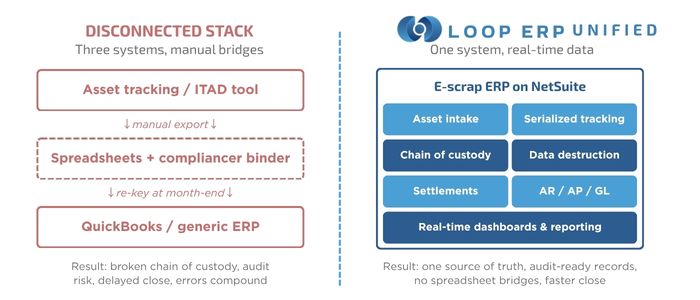
The result is a patchwork: a generic ERP for the books, an asset or ticketing tool for the floor, spreadsheets between them, a compliance binder for the audit, and no single source of truth for anything important. The cost shows up in headcount, in delayed financial visibility, in compliance risk, and in the quality of decisions the leadership team can make about pricing, customer mix, and capacity.
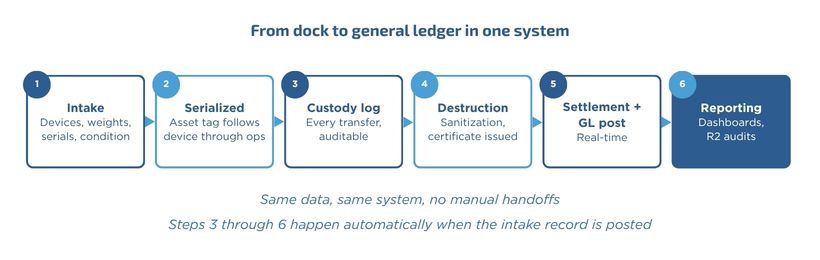
An e-scrap ERP is only worth the name if it handles the full operational chain natively, without bolted-on integrations and without spreadsheet bridges. The list below is the minimum scope. Any of these missing or weakly supported will create the same patchwork cost the system was supposed to eliminate.
The intake event is the primary transaction record. A real e-scrap ERP captures devices, weights, serial numbers, asset tags, and condition codes at the moment material crosses the dock, ties the load to a customer or supplier, and feeds the record into serialized inventory and chain of custody automatically. No re-entry. No nightly batch.
Once an asset is in the system, it carries its identity through every step that follows. Refurb, test, wipe, shred, or downstream ship. Each movement updates the same record. Lot-level and bulk modes are supported for material that does not warrant serial tracking, but the system understands which is which.
Every transfer, process step, and downstream movement is logged against the asset. The custody record updates in real time. Auditors get a clean trail from dock to final disposition without a controller reconstructing it from three systems the week before the audit.
In a circular economy program, data sanitization is the step that unlocks reuse. A device cannot return to productive use until its data is cleared to NIST 800-88 (or customer-specified) standards, and the record of that clearance is what customers, regulators, and downstream buyers rely on. The system ties sanitization events to specific serial numbers, with method, technician, date, and verification captured in the same transaction. Devices that pass move into refurbishment or certified resale workflows. Devices that cannot be reused proceed to destruction with the same audit trail. The certificate (sanitization or destruction, whichever applies) is generated from that record, and the financial event posts at the same time.
Multi-stage material recovery is a first-class workflow, and the recovery is the point. Disassembly, sortation, shredding, and recovery feed downstream inventory in the form the next buyer expects, whether that is refurbished units returning to productive use, separated secondary commodities (copper, aluminum, steel, precious metals, plastics) re-entering the supply chain, or shredded mixed material for downstream specialists. Cost basis follows the asset through every transformation, and so do the recovery yield and diversion metrics that customers and sustainability teams report on.
Settlements account for customer contracts (revenue share, fee-based, hybrid, producer-funded), vendor purchase terms on recovered downstream commodities, and any deductions or recovery splits the contract specifies. A purpose-built system handles this natively and posts to AR and AP without manual override.
R2v3, e-Stewards, NIST 800-88 data sanitization standards, state-level e-waste laws, EPR (extended producer responsibility) submissions, producer-funded program reporting, and downstream vendor audit records all tie back to the underlying transactions. The compliance trail is the transaction trail. There is no parallel system to reconcile, and no sustainability spreadsheet someone has to maintain alongside the books.
Most electronics recyclers of any scale run more than one facility, often across legal entities or regions. The system has to consolidate intake, inventory, custody, and financials across sites in real time, with role-based access so site managers see their facility while corporate sees the whole picture through real-time dashboards.
Intake happens at the dock. Transfers happen on the floor. Drivers, technicians, and operations leads need purpose-built mobile workflows that feed the same data set the controller looks at on Monday morning.
The financial layer is not optional. An e-scrap ERP either includes a full AR, AP, GL backbone (multi-entity, multi-currency where it matters, revenue recognition, reporting, audit trail) or it is not really an ERP. It is an asset tool pretending. Loop ERP includes this natively because it is built directly on Oracle NetSuite.
The category overlap creates a lot of confusion. Three product types compete for the same buyer, and they are not interchangeable.
ITAD or asset-tracking software runs the floor. Serial capture, asset records, basic chain-of-custody logging, sometimes a destruction module. It does not run the books. If you use it, you still need a separate accounting or ERP system to handle AR, AP, GL, and reporting, which means you still need a bridge between the asset tool and the financial system.
Generic ERP runs the books. Strong on financials, strong on standard manufacturing or distribution workflows, weak on anything serial-by-default, custody-bound, or compliance-linked. Configurable, but every e-scrap-specific behavior has to be built. Implementation gets long. Customization gets expensive. Upgrades get complicated.
E-scrap ERP (purpose-built) runs both, in one system, with the industry workflows already in place. Asset intake, serialized tracking, chain of custody, data destruction, processing, settlements, and R2 documentation are native, not custom. Finance and operations share the same data model.
Here is how the three options compare on the workflows that matter most:
The right question is not which of the three is best in absolute terms. It is which one matches the way your business actually runs, today and at the next stage of growth. Most electronics recyclers get to the conversation about ERP because the patchwork has stopped scaling. At that point, e-scrap ERP is usually the cleanest answer.
If you are evaluating e-scrap ERP options, the following 13 criteria separate purpose-built systems from systems that have been customized to look the part. Score each option from 1 (not supported) to 5 (fully native). Total possible: 65.
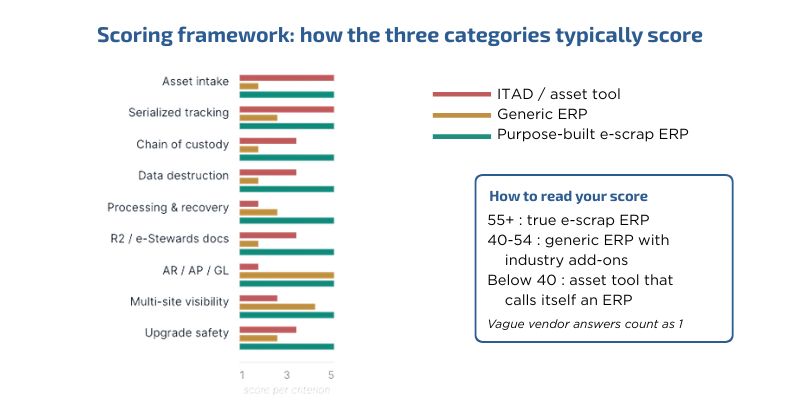
A score of 55 or above across the 13 categories suggests a true e-scrap ERP. A score in the low to high 40s usually means a generic ERP with industry add-ons. A score below 40 means you are looking at an asset tool that calls itself an ERP.
The ranges are deliberately rough. The point of the exercise is to make the conversation specific. Vague answers like "yes, we can support that" become specific answers like "out of the box, we score this at 4 because chain-of-custody updates require an admin user to confirm each transfer manually." That is the level of detail you need to make a real comparison.
If a vendor cannot answer the 13 questions in concrete terms, that is the answer.
Want to run Loop ERP through this checklist?
Book a working session and we will walk a real intake, custody transfer, and certificate of destruction through the system, scoring each criterion on its actual out-of-the-box behavior. No slides. Schedule a working session.
The shift is easiest to see side by side. The left column is the daily reality at most electronics recyclers running on a patchwork. The right column is what the same operation looks like inside a purpose-built e-scrap ERP.
E-scrap ERP fits operations where serialized assets, chain of custody, circular economy outcomes, and compliance drive the business, and where the financial picture has to keep up with what is happening on the floor. The pattern shows up across several adjacent operations and stakeholder groups.
The most common entry point is the operator who has outgrown QuickBooks, generic accounting tools, or a standalone asset-tracking platform. The patchwork worked at one facility. It stopped working somewhere between site two and site five, when manual reconciliation started eating real time, the audit trail stopped holding together, and the sustainability team started asking for numbers nobody had time to assemble. If that is where the business is, the ERP question is no longer theoretical. The patchwork is already costing real time, and e-scrap ERP is the cleanest way to stop paying that tax.
Loop ERP is a purpose-built e-scrap ERP for electronics recycling and similar materials-based industries, built directly inside Oracle NetSuite. There is no API layer between operations and finance because there are not two separate systems. Asset intake, custody transfers, destruction events, settlements, and GL postings all happen inside the same platform.
Here is what that looks like across the workflows that drive an electronics recycling business.
Intake records are created at the dock, with devices, weights, serial numbers, asset tags, and condition codes captured directly. Each record is tied to a customer or supplier, a contract, and the chain-of-custody trail that follows. There is no nightly batch, no spreadsheet bridge, no re-entry into a separate accounting system.
The moment an asset is logged at intake, it appears in inventory inside the same system. Lot, bulk, and serialized modes are supported in parallel. Operations and finance see the same numbers in the same place, with no 24-hour lag between floor activity and reporting.
Every transfer, process step, and downstream movement updates the asset record. Loop preserves the history and the timestamp on each step. Auditors get a clean trail. Controllers stop reconstructing how a destruction certificate issued last week relates to the customer billing on the books this month.
Sanitization events tie to the asset record. Method, technician, date, and verification are captured at the moment the work happens. Devices that pass move into refurbishment or certified resale workflows. Devices that cannot be reused proceed to destruction with the same audit trail. The certificate (sanitization or destruction, whichever applies) is generated from that record, and the financial event posts at the same time. The same data feeds R2 audit reports and customer-facing reporting.
Multi-stage processing is a first-class workflow. Disassembly, sortation, shredding, and downstream movement feed inventory in the form the next buyer expects. Cost basis follows the asset through every transformation.
Loop calculates customer and vendor settlements directly from the asset and processing data, applying contract terms, deductions, and revenue share where the contract specifies it. Approvals run inside the system. The settlement posts to AR or AP automatically.
R2v3, e-Stewards, NIST 800-88, state e-waste laws, and downstream vendor audit records tie back to the underlying transactions. The compliance trail is the transaction trail. There is no parallel system to reconcile, and no separate database to keep aligned with the books.
Because Loop is built natively inside NetSuite, you get the full financial suite (AR, AP, GL, multi-entity, multi-currency, revenue recognition, audit trail) with operational data feeding it in real time. Forecasting reports, throughput metrics, recovery yield analysis, and credit limit tracking all run on the same data set.
This is what "closing the loop between operations and finance" looks like in software. One login. One system. Total operational control. The patchwork goes away because the system was built for the job in the first place.
Loop ERP is built by people who have lived the operational pain in scrap, recycling, electronics, brokerage, and similar materials-based industries, and the design choices reflect that. Loop ERP is also a member of the Recycled Materials Association (ReMA) and the Canadian Association of Recycling Industries (CARI-ACIR), and works alongside operators who shape the standards in both markets. The shortest way to evaluate whether the system fits your operation is to walk a real workflow through it, on a demo, with your own intake, custody transfer, and recovery scenarios.
Because Loop captures every asset movement in one transaction record, the circular economy metrics below are outputs of the system your operations team already runs, not a separate reporting layer.
An e-scrap ERP is the operational backbone of a circular economy program. The mission is to keep materials in productive use longer, recover what cannot be reused, and divert what cannot be recovered. The system makes that mission measurable.
Because every asset, transfer, sanitization, and downstream movement is captured in one transaction record, the data needed for circular economy reporting is already there. No parallel sustainability database. No quarterly scramble to reconstruct material flows from spreadsheets. The outputs that matter to CE-motivated buyers, OEMs running take-back programs, corporate sustainability teams, and EPR-funded recycling networks all come from the same source data the operation already runs on.
The system tracks what came in, what was refurbished and returned to productive use, what was recovered as secondary commodity, and what reached final destruction. Reuse rate, recovery yield, and disposition mix are queries, not estimates.
Weight and category data captured at intake, combined with downstream disposition records, produce a verifiable diversion number by facility, by customer, and by material stream. The figure stands up to OEM audits and corporate sustainability reporting requirements.
For programs that prioritize reuse over recovery (and the value gap between the two is significant), the resale-to-shred ratio is the single clearest health indicator. The system reports it natively, by facility, by inbound program, by device class.
The activity data needed to estimate avoided embodied carbon (weight by category, refurbishment yield, recovered commodity output, downstream destination) comes out of the same transaction stream that runs settlements. Sustainability teams stop chasing operations for end-of-quarter spreadsheets.
For operations participating in extended producer responsibility frameworks, the reportable data sits in the system already. Producer-funded volumes, qualifying material categories, and downstream destination records all tie back to the asset and the contract that brought it in. EPR submissions become a query rather than a reconstruction project.
OEM take-back contracts, corporate decommission programs, and leasing recovery agreements increasingly include sustainability reporting requirements. The system generates customer-facing reports from the same data that powers the operational dashboards, without manual assembly.
The strategic frame: Operational unification is the prerequisite for circularity at scale. The same transaction record that tells finance how much to bill a customer also tells the sustainability team how much material that customer kept out of the landfill, how much returned to productive use, and which downstream vendor finished the loop. Run those numbers in separate systems, and they will not agree. Run them in one system and they will.
E-scrap ERP is enterprise resource planning software built specifically for electronics recycling operations. Unlike generic ERP, an e-scrap ERP handles the industry's core workflows natively: asset intake, serialized tracking, chain of custody, data destruction, multi-stage processing and recovery, customer and vendor settlements, and R2 compliance documentation. The goal is to connect floor operations and finance inside a single system, eliminating the need for separate asset-tracking software, spreadsheets, or manual reconciliation.
ITAD and asset-tracking software typically focus on the floor: serial capture, asset records, custody logging, and sometimes a destruction module. A full e-scrap ERP extends that into financial management, including AR, AP, settlement processing, general ledger posting, and real-time financial reporting. The distinction matters because managing operations and finance in separate systems is where most reconciliation work, audit risk, and data errors originate.
Generic enterprise ERP systems can be customized to accommodate electronics recycling workflows, but the customization is substantial. Serialized asset tracking, chain-of-custody logging, certificate-of-destruction workflows, downstream vendor traceability, and R2 documentation are not standard features. That customization is expensive to build, costly to maintain across upgrade cycles, and often produces a system that approximates your workflow rather than fitting it. A purpose-built recycling ERP, or a NetSuite-based e-scrap solution designed for the industry, gives you those capabilities without the customization risk.
R2v3 expects an unbroken record from intake through final disposition, including chain-of-custody documentation, data sanitization records, and downstream vendor traceability. An e-scrap ERP captures all of that data at the source and ties each record back to the underlying transaction. Audit reports run from the same data set that the financial close runs on, which means the audit trail and the books agree by construction rather than by manual reconciliation. For a deeper look at what R2v3 requires from your system specifically, see R2 Certification and Your ERP: What Auditors Actually Check.
Yes. Serialized tracking is a first-class data model, not a workaround. Serial numbers, asset tags, and customer-specific identifiers travel with the asset through every transfer, process step, and downstream movement. Lot and bulk tracking are supported alongside, for material that does not warrant serial-level detail.
Data sanitization events tie to specific serial numbers, with method, technician, date, and verification recorded in the same transaction. The certificate of destruction is generated from that record and matched to the customer it belongs to. The financial event posts at the same time, so the destruction record, the customer-facing certificate, and the books all agree without manual entry.
Yes, and that is the most common starting point. Electronics recyclers usually outgrow QuickBooks somewhere between the first and the third facility. The audit trail starts to break, the compliance binder gets harder to defend, and finance starts pulling weekend hours reconciling asset records against revenue. An e-scrap ERP replaces the patchwork with one system that runs the floor, the books, and the audit on the same data.
Implementation timelines vary based on the size of the operation, the number of facilities, the integrations required, and how much process documentation already exists. Most Loop ERP implementations run a few weeks to a few months. The work breaks into discovery (mapping current workflows), configuration (chart of accounts, customer contracts, sanitization methods, downstream vendors), data migration, training, and parallel operation. A well-run implementation pays back in the first quarter through reduced reconciliation work and faster month-end close.
Each downstream movement is logged against the asset and the destination vendor. The system captures what material went where, in what form, on what date, with the supporting documentation tied to the asset record. R2 audits draw from that same data, which means downstream traceability is a query, not a reconstruction.
Sustainability reporting depends on activity data: weight by material category, recovery yield, refurbishment volumes, diversion from landfill, and downstream disposition. An e-scrap ERP captures all of that as part of the operational transaction stream, so ESG reports run on the same data the financial close runs on. Customer-facing reports (OEM take-back fulfillment, corporate decommission sustainability summaries, EPR program submissions) come from the same source, without a parallel reporting database to maintain.
Yes. For operations participating in extended producer responsibility frameworks, the reportable data sits in the system already. Producer-funded volumes, qualifying material categories, weight by stream, and downstream destination records all tie back to the asset and the contract that brought it in. EPR submissions become a query rather than a quarterly reconstruction project.
The circular economy hierarchy prioritizes reuse over material recovery, and material recovery over disposal. In practice, that means a device should return to productive use whenever it can pass data sanitization, functional testing, and customer specifications. An e-scrap ERP supports this by treating sanitization as the gate that unlocks reuse, not as a step toward destruction. The system records the sanitization method, technician, date, and verification on the asset record. Devices that pass move into refurbishment, certified resale, or return-to-customer workflows. Devices that fail proceed to material recovery, and only the residual moves to certified destruction. The reuse rate becomes a measurable outcome the operation can report back to OEM partners, leasing customers, and corporate sustainability teams, with the certificate of sanitization or destruction tied to the same transaction record.
No. Single-facility operations benefit from an e-scrap ERP because they typically run on the lightest patchwork of asset tools and accounting software, which means every transaction generates manual work. Multi-site operations benefit because the consolidation problem is harder. The system is designed to scale from one facility to a multi-entity, multi-region group on the same platform, so the decision is less about size and more about whether the current setup is creating cost.
Bring a real workflow. A real intake from last week, a real custody transfer, a real destruction event with a customer-facing certificate. Watch the vendor walk those exact transactions through the system. The right product will handle them without leaving the screen. The wrong product will reach for "we can configure that" or "that would be a custom build." The demo is not about the marketing slides. It is about whether the system handles your work the way it actually shows up.
Running electronics recycling on the wrong system creates two compounding costs. Operationally, every manual reconciliation, every spreadsheet bridge, every audit week spent rebuilding chain-of-custody, and every quarter-end sustainability scramble is a tax the business pays for using software that was not built for the work. Strategically, the same patchwork puts a ceiling on the circular economy program. Reuse rates that cannot be proven. Diversion numbers that cannot be defended. Customer reporting that does not scale.
An e-scrap ERP closes that gap. The floor, the financials, the compliance work, the sustainability reporting, and the leadership dashboards run inside the same system because the system was built for the way electronics recycling actually works.
If you want to see what that looks like for your operation specifically, book a working session with Loop ERP. Bring a real intake, a real custody transfer, and a real recovery or destruction event. We will walk it through the system end to end.
Powerful, self-serve product and growth analytics to help you convert, engage.
Blogs
September 23, 2026
Closing the Books on Q3: Why Manual Reconciliation Breaks Down at Quarter-End
September 16, 2026
Material Traceability Software: What ESG and Compliance Teams Actually Need
September 10, 2026
Scale House Software Explained: Ticketing, Dispatch, and the Financial Handoff