Picture a truck rolling off the scale at 6:40 a.m. with 24.6 tons of three-quarters minus on the ticket. By Friday, that number has been read by a scale operator, retyped by an office manager, adjusted by someone who spotted a mismatch, and questioned by a customer who thinks the invoice is wrong. Nobody did anything careless. The weight just passed through too many hands to stay the same.
For aggregate producers, that is what a disconnected weight ticket costs: hours in the office, invoices that need a second look, and a cost per ton nobody fully trusts. A weight ticket ERP fixes it by treating the ticket as the starting point for the books instead of a document someone has to carry over to them.
A weight ticket, often called a scale ticket, is the record created when a loaded truck crosses the scale. It captures gross weight, tare weight, and net tons, along with the product, customer, truck, and time stamp. Everything else in the business reads from it: the customer invoice, the stockpile balance, the hauler's pay, and any royalty or tax calculation that depends on tonnage.
Aggregate is sold by the ton and moved a short distance. Freight often costs more than the stone itself once a load travels far enough, which is why producers commonly serve customers within roughly 20 to 25 miles of the pit. When margin depends on tons and haul cost, a small error on one ticket matters, and a busy site can see dozens to hundreds of tickets in a day.
That makes the weight ticket the most important piece of data in the operation. It also tends to be the least protected, because it often lives in weighbridge software that does not share a record with the accounting system.
Many independent producers run a standalone scale printer or basic ticketing software, QuickBooks for accounting, and a spreadsheet for stockpile counts. Regional operators usually have a different version of that setup at each pit or plant. The pieces work on their own, and the trouble starts where one hands off to the next.
Three costs show up in the office.
Time. Someone keys ticket weights into the invoice, or exports a file and cleans it up first. At a few loads a day that is a nuisance. At a few hundred it is a job.
Accuracy. A ticket gets corrected at the scale house after the invoice went out, and the fix reaches one system and not the other. The customer finds it before you do.
Visibility. Cost per ton depends on net tons, production cost, haul cost, and any royalty paid per ton. When each number lives in a different place, the answer is an estimate pulled together days after the fact. By then, the pricing decision it should have informed is already made.
The gap gets wider with each pit you add. A controller comparing three sites may spend days each month matching scale tickets to the ledger before the close can start. And when the one person who knows how the spreadsheet works is out sick, billing waits.
Here is how the same questions look in a patchwork of systems and in one system:
The principle is that a weight gets recorded once, at the scale, and the other records use that weight without anyone typing it again.
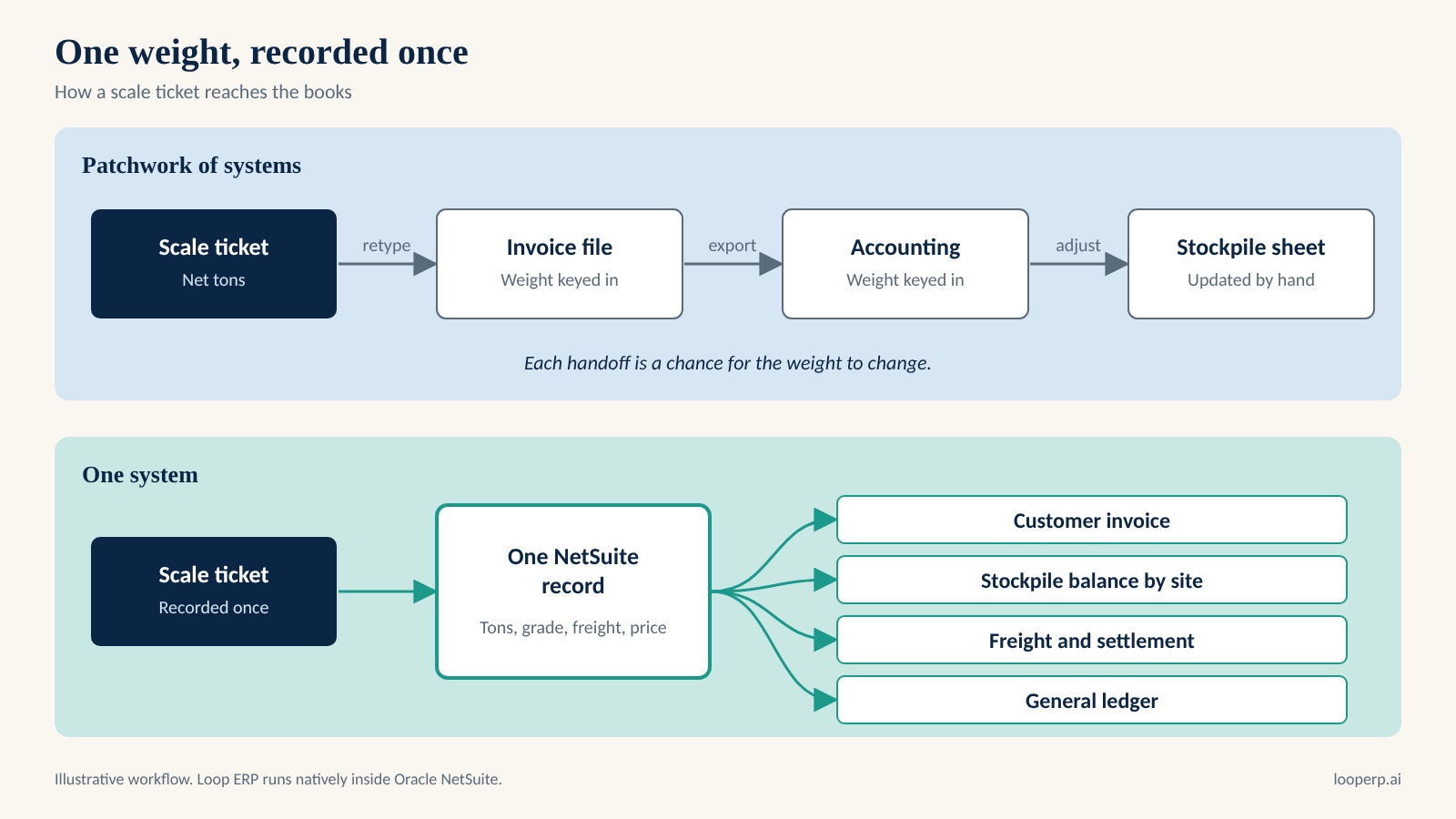
When that holds, the invoice comes from the ticket, the stockpile balance moves with the ticket, and freight and settlement amounts attach to the same load. Finance reads the result from the general ledger instead of rebuilding it from exports. When a grade or weight changes later, inventory and margin change with it, and the edit carries a user name and a time stamp so you can see who changed what.
If you are evaluating software, three questions will tell you quickly whether a system works this way:
If the answers involve an export, a file import, or a person watching for mismatches, the ticket and the books are still two separate things. That matters most for operators with multiple pits, where each manual step repeats at each site.
A good aggregate ERP also has to price the way aggregate sells. Prices vary by product, grade, spec, and customer. Freight and fuel surcharges get added by zone or distance. Generic ERP tools assume units and SKUs, so those rules often end up in spreadsheets next to the system instead of inside it.
Loop ERP is built around the scale ticket and runs natively inside Oracle NetSuite. For a quarry ERP NetSuite buyer, that means the operational record and the financial record are the same record, with no separate accounting package to keep in step.
In practice, certified weights from connected scales flow into inventory, billing, and reporting without anyone re-entering them. Customer invoices are generated from ticket data. Vendor and hauler settlements work from net weight and grade, with support for deductions, freight netting, and multi-party deals. The Flexible Pricing Module handles pricing by index, grade, and spec. For operators with more than one site, a single dashboard shows tonnage, output, haul times, and stockpile levels by location, and finance and dispatch work from the same numbers.
Loop Services, the Oracle NetSuite Solution Partner behind Loop ERP, handles migration, workflow setup, scale house connectivity, and training alongside your operations team. Timing depends on the number of sites and material streams you run.
A weight ticket ERP and any cost per ton software built on it are only as good as the records feeding it. When tons, freight, and settlement amounts sit on the same NetSuite records as the financials, the number a controller reports can be traced back to the tickets behind it.
If your office is still carrying weights from the scale to the books by hand, a short walkthrough of your own volumes will show you where the time goes.
Book a demo to see how Loop ERP connects your scale house to finance.
A weight ticket ERP is an ERP system that uses the scale ticket as its starting record. Net tons from the scale drive invoicing, inventory, freight, settlements, and financial reporting, so the same weight is not entered again in each system.
Cost per ton is total cost divided by net tons. The calculation is only as reliable as its inputs, so the tons, production costs, haul costs, and per-ton royalties need to come from the same system of record. When they come from separate files, the result is an estimate.
Yes, if the ERP is built for the work. Loop ERP is a Built for NetSuite certified SuiteApp that puts scale tickets, stockpile tracking, dispatch, pricing, and settlements inside Oracle NetSuite alongside the accounting.
In Loop ERP, ticket edits, grade changes, and settlement adjustments carry a user stamp and a time stamp. A grade adjustment updates inventory and margin together, so the correction does not need to be made in a second place.
It should. Loop ERP lets you monitor tonnage, output, haul times, and inventory across sites from one dashboard, with finance and dispatch working from the same records.
Powerful, self-serve product and growth analytics to help you convert, engage.
Blogs
October 9, 2026
Weight Tickets, Cost Per Ton, and ERP: How Aggregate Producers Connect Operations to Finance
October 1, 2026
Building the 2027 Budget: How to Make the ROI Case for a Scrap ERP Before Year-End
September 23, 2026
Closing the Books on Q3: Why Manual Reconciliation Breaks Down at Quarter-End