You bought 40 tons of copper at Tuesday's price. By the time it ships three weeks later, the market has moved 6 percent. So what was your margin on that load?
Most recyclers can't answer that question with confidence, and it isn't because they're bad at math. It's because their inventory is booked at one price, sold at another, and valued by a spreadsheet that was accurate the last time someone updated it. In an industry where commodity prices move daily, that gap between booked value and market value quietly distorts every margin number finance reports.
This article covers why static inventory costing misleads recyclers, what real-time valuation actually requires, and how scrap inventory valuation software keeps the numbers honest across scrap metal, e-scrap, and aggregate operations.
Recycling inventory is unlike inventory in almost any other industry. A distributor buys widgets at a fixed cost and sells them at a fixed markup. A recycler buys material whose value changes every day it sits in the yard.
Here's how the distortion plays out:
That margin number is real in an accounting sense, but it hides the decision-making picture. If copper dropped 8 percent while the material sat in the yard, part of that "margin" is actually a holding loss the operation absorbed without ever seeing it on a report. If the market rose, the yard looks more skilled than it is, and nobody asks whether inventory turned fast enough.
Multiply this across hundreds of commodity grades, multiple yards, and daily price movement, and the monthly P&L becomes a blend of trading gains, holding losses, and operational margin that no one can separate. Finance is honest, but the numbers aren't.

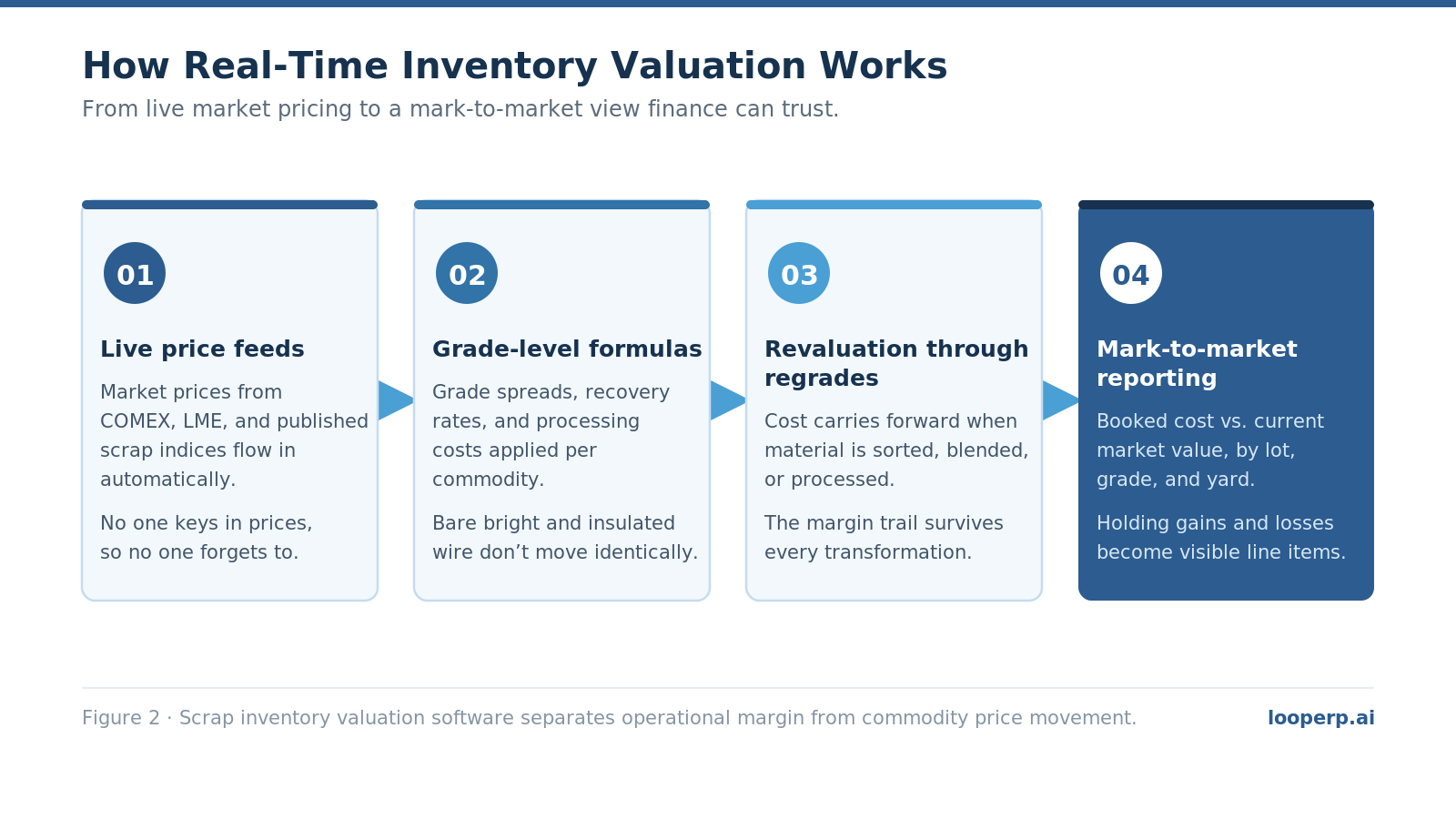
Scrap inventory valuation software continuously values recycled material inventory against live commodity pricing rather than static purchase cost. It connects each inventory lot to a market index (such as COMEX, LME, or published scrap indices), applies grade-specific formulas and recovery rates, and recalculates inventory value as prices move. The result is a mark-to-market view of what material in the yard is worth today, alongside the booked cost, so finance can separate operational margin from commodity price movement.
That last distinction is the point. Operational margin is what the business earns by buying, processing, and selling material well. Price movement is what the market did while you held it. A recycler who can't separate the two can't tell whether a good quarter came from good operations or a rising market, and can't tell whether a bad quarter is a pricing problem or a process problem.
Plenty of recyclers track inventory value in Excel, and the spreadsheet usually starts out fine. It fails for three predictable reasons.
Prices update faster than people do. A controller who refreshes market prices weekly is valuing inventory against data that's already stale. Daily updates are a full-time job across dozens of grades, so they don't happen.
Regrades break the cost trail. Material rarely sells as the grade it was purchased as. Mixed loads get sorted, e-scrap gets demanufactured into recovered commodities, aggregate gets crushed and screened into new products. Every transformation changes what the material is worth and muddies what it originally cost. Spreadsheets track one or the other, rarely both.
Multi-site operations compound the lag. Each yard maintains its own version of inventory value, and corporate consolidates at month-end. By the time finance sees a rolled-up number, it reflects prices from two to four weeks ago. For a deeper look at the visibility side of this problem, see our guide to material tracking software for multi-site operations. Tracking where material is and tracking what it's worth are different problems, but they fail for the same reason: disconnected systems that only agree at month-end.
The mechanics differ by material stream, but the requirements are consistent.
Live price feeds tied to inventory records. Market prices from published indices flow into the system automatically, and every lot in inventory carries both its booked cost and its current market value. No one keys in prices, so no one forgets to.
Grade-level formulas. #1 copper, bare bright, and insulated wire don't move identically, and neither do the recovered commodities inside a pallet of servers. Valuation formulas account for grade spreads, recovery percentages, and processing costs so the market value reflects what the material will actually fetch.
Valuation that survives transformation. When material is regraded, blended, or processed into a new product, the system carries cost forward and revalues against the new grade's market price. The margin trail stays intact from scale ticket to settlement.
Mark-to-market reporting for finance. Finance sees booked cost, current market value, and the variance between them, by grade, by lot, by yard. Holding gains and losses become visible line items instead of noise buried in gross margin.
This applies across the industry, not just to scrap metal. E-scrap processors hold inventory whose value swings with gold, palladium, and copper recovery prices. Aggregate producers see less commodity volatility on the material itself but face the same booked-versus-current gap when fuel, freight, and regional pricing shift what a stockpile is worth delivered.
Loop ERP was built for recycling and materials operations on NetSuite, which means inventory valuation isn't a bolt-on report. It's the same system that runs the scale house, the yard, and the general ledger.
Material enters at the scale with its grade and purchase cost captured once. As it moves through sorting, regrading, or processing, Loop ERP maintains the cost and quantity trail automatically. Live commodity pricing values that inventory continuously, and because operations and finance run on one system, the mark-to-market view lands directly in financial reporting with no re-keying and no month-end reconciliation scramble. Our post on how scrap recycling ERP delivers real-time operational and financial alignment walks through that architecture in more detail.
The practical outcome: when the CFO asks what inventory is worth today and what margin last month really was, there's one answer, and it's current.
How is inventory valuation different from material tracking? Material tracking answers where material is and what happened to it. Inventory valuation answers what it's worth right now and what margin it will produce. Both matter, and both fail in disconnected systems, but valuation is the finance-facing half of the problem.
Can't we just revalue inventory at month-end? You can, and most recyclers do. But month-end revaluation tells you what happened, not what's happening. Buying, selling, and hedging decisions get made daily, against prices that moved this morning.
Does real-time valuation require hedging? No. Hedging is one response to price exposure, but you can't decide whether to hedge, or measure whether hedges worked, without knowing your current inventory position and value. Valuation comes first.
Commodity prices will keep moving daily. The question is whether your inventory value moves with them or sits frozen at purchase cost until month-end. Recyclers who value inventory against live pricing can separate operational margin from market movement, spot holding losses while there's still time to act, and give finance numbers that hold up.
See how Loop ERP connects yard operations, inventory valuation, and finance in one system. Book a demo.
Powerful, self-serve product and growth analytics to help you convert, engage.
Blogs

October 9, 2026
Weight Tickets, Cost Per Ton, and ERP: How Aggregate Producers Connect Operations to Finance
October 1, 2026
Building the 2027 Budget: How to Make the ROI Case for a Scrap ERP Before Year-End

September 23, 2026
Closing the Books on Q3: Why Manual Reconciliation Breaks Down at Quarter-End