

An auditor doesn't ask if you have a chain of custody process. They ask you to prove it, serial number by serial number, load by load, signature by signature. For e-scrap and ITAD operations, that's where a lot of otherwise solid programs fall apart. The process exists on paper. It just doesn't hold up when someone pulls a random device and asks where it's been.
Chain of custody is the backbone of R2v3, e-Stewards, and NIST 800-88 compliance, and it's also what your customers are relying on when they hand over a pallet of retired laptops or a rack of servers with live data still on the drives. If you can't reconstruct that device's full path, from the moment it hit your dock to the moment it was destroyed, resold, or recycled, you don't have a defensible chain of custody. You have a guess with paperwork attached.
This post covers the three workflows that make or break an audit: photo documentation, load tracking, and signature capture, and how e-scrap operators are closing the gaps that show up when compliance teams go looking.
Scrap metal and aggregates track material by weight, grade, and lot. E-scrap and ITAD have to track by individual serial number, and that number carries data security risk, not just material value. A single pallet might contain 40 laptops from 12 different clients, each with its own data destruction requirement, its own downstream disposition, and its own customer expecting a certificate at the end.
That's a different level of granularity than most ERPs, or most spreadsheets, were built to handle. Add in R2v3's downstream due diligence requirements, state EPR laws, and NIST SP 800-88 Rev. 2 media sanitization records for federal or CMMC-covered clients, and a single device can trigger three separate compliance obligations at once. Miss one, and the whole shipment becomes a liability instead of an asset recovery win.
Most operations already do some version of chain of custody. The problem is where it lives.
Intake photos sit on a technician's phone. Load manifests are a printed sheet that gets signed, scanned, and filed in a folder nobody opens again until an audit request comes in. Signature capture happens on paper, on a tablet app that doesn't talk to the ERP, or not at all if the driver is in a hurry. None of it is connected to the serial number, the lot, or the financial record of the transaction.
When an auditor or a customer asks for the full custody trail on asset tag #4471, someone has to go find the photo, match it to a handwritten manifest, track down the driver's signature, and hope the timestamps line up. That's hours of work for one device. For a facility processing thousands of units a month, it's not a process. It's a liability waiting to surface at the worst possible time.
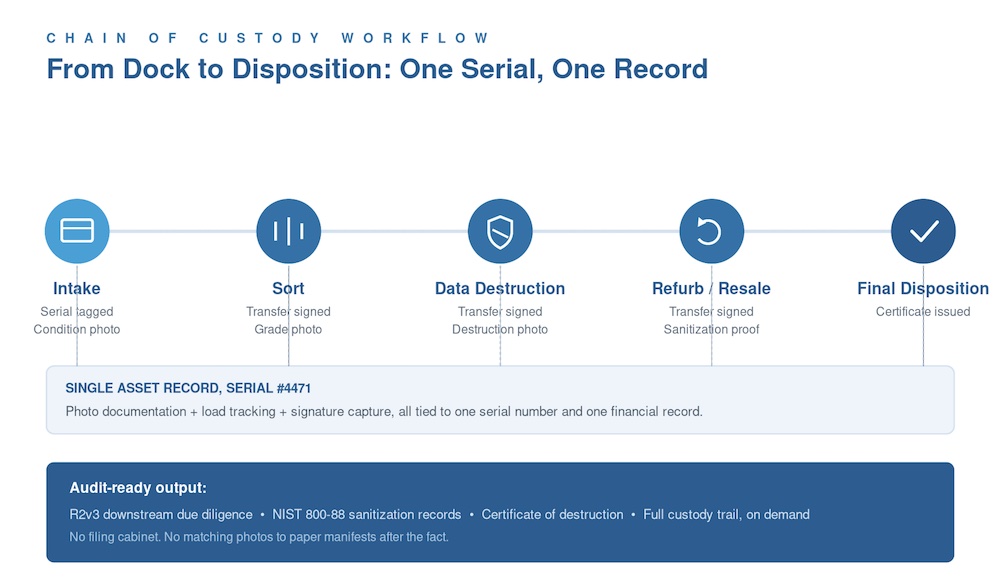
Photos matter because they're evidence of condition at each custody event: intake, sorting, data destruction, and final disposition. But a photo sitting in a phone's camera roll proves nothing to an auditor. It needs to be timestamped, geotagged where possible, and attached directly to the asset's serial number in the system of record.
That means when a device comes in damaged, the photo is captured at intake and locked to that record permanently. When a drive is shredded, the photo of the destroyed media is attached to the same serial number, not a separate folder that has to be cross-referenced later.
A load isn't one event. It's a chain of transfers: inbound truck to receiving dock, receiving to sort, sort to data destruction or refurbishment, and finally to a downstream vendor or resale channel. Each transfer is a custody event, and each one needs a record showing who handled it, when, and what condition the material was in.
Load tracking that lives in a spreadsheet or a standalone scanning app can tell you a load arrived. It usually can't tell you, in one query, everything that happened to every serial number inside that load after it left the truck. That gap is exactly what shows up when a customer asks for a full disposition report on a shipment from six months ago.
A signature proves a specific person accepted custody at a specific moment. That's only useful if it's tied to the transaction it belongs to: this driver, this load, this timestamp, these serial numbers. A stack of signed paper manifests in a filing cabinet doesn't answer an auditor's question any faster than no signature at all, because someone still has to find the right page and match it to the right load.
Digital signature capture, connected directly to the load and the asset records, turns that lookup into a report you can pull in minutes instead of a scavenger hunt through file boxes.
An audit-ready chain of custody means any serial number, at any point, can be traced back through every custody event: who received it, who photographed it, who transferred it, who signed for it, and where it ended up. That record needs to connect to the financial transaction too, because a device's disposition affects revenue recognition, settlement with the customer, and downstream vendor accountability.
This is where the disconnect between operations and finance becomes a compliance problem, not just an efficiency one. If your ITAD tracking lives in one system and your financial and customer records live in another, you're reconciling two versions of the truth every time someone asks a question. During an audit, that reconciliation gap is exactly what gets flagged.
Loop ERP is built natively on NetSuite for circular economy operations, including electronics recyclers and ITAD providers. That means photo documentation, load tracking, and signature capture aren't bolted onto a separate app. They're attached directly to the same serial-level record that drives your financial reporting.
A device gets tagged at intake, and every custody event, photo, transfer, signature, and disposition builds on that single record. When R2v3 downstream due diligence documentation is due, or a customer wants a certificate of destruction with full traceability, the record already exists. Nobody has to reconstruct it from three different systems and a filing cabinet.
Chain of custody isn't a document you produce when someone asks for it. It's a system that produces the document automatically, because every custody event was captured where it happened, not reassembled after the fact. Photo documentation, load tracking, and signature capture only work as compliance evidence when they're connected to the same serial number, the same load, and the same financial record from day one.
If your current process depends on someone remembering to take a photo, print a manifest, or chase down a signature, it's not a matter of if a gap shows up during an audit. It's when.
Chain of custody in IT asset disposition is the documented record of every party who handled a device, from the moment it's collected from a customer to its final disposition, whether that's resale, refurbishment, or destruction. Each transfer needs a timestamp, a signature, and, in most cases, a serial number tied to the specific device.
R2v3 requires certified facilities to track material with no gaps between receipt and final disposition, including documentation of downstream vendors and verification of where each device or component ultimately ended up. For ITAD specifically, that means serial-level tracking, not batch or lot-level tracking, since each device can carry its own data security requirement.
Auditors look for a combination of records tied to the same asset: intake photos showing condition on arrival, signed manifests for each transfer between custody points, data destruction certificates where applicable, and a final disposition record showing whether the device was resold, refurbished, or recycled. The records need to connect to each other by serial number, not exist as separate documents an auditor has to match up manually.
Photos should be timestamped and attached directly to the asset's record at the moment each custody event happens: intake, sorting, data destruction, and final disposition. A photo stored separately from the asset record, such as in a phone's camera roll or a shared drive folder, doesn't hold up as evidence because there's no verifiable link between the image and the specific device.
A gap in the chain, meaning a custody event with no record of who handled the device or when, can result in a finding against your R2v3 or e-Stewards certification and puts your customer's compliance at risk too, since they're relying on your documentation for their own EPR, FISMA, or CMMC obligations. Repeated gaps are one of the most common reasons ITAD facilities lose certification during recertification audits.
Most certifications and customer contracts require chain of custody records to be retained for a minimum of three years, though some state EPR laws and federal contracts require longer. Because retention requirements vary by certification, state, and customer contract, ITAD operators should confirm the specific retention period with each certifying body and customer agreement rather than defaulting to a single standard.
Yes. A device headed for resale or refurbishment still needs a full custody record, including proof that any data-bearing components were sanitized or destroyed before resale. Chain of custody isn't only about proving destruction; it's about proving control over the device at every step, regardless of its final disposition.
See how Loop ERP connects intake, custody tracking, and finance in one system built for e-scrap and ITAD operations. Book a demo to see it on your own material flow.
Powerful, self-serve product and growth analytics to help you convert, engage.
Blogs

September 10, 2026
Scale House Software Explained: Ticketing, Dispatch, and the Financial Handoff

September 3, 2026
What ERP Do Scrap Yards Use? A Buyer's Guide for Q4 Planning Season

August 27, 2026
When Inventory Aging Costs More Than the Material: How to Optimize Summer Stockpiles


